We live out in the county. That is a way of saying 'out in the country' or 'out in the sticks' or 'out in the boonies'. Sure the road out front is two-lane blacktop. And yes, the "highway" that is half a mile away is two-lane blacktop as well but out here at the 12 Mile marker we are about as far away from things as a body can get. Why, any farther away and ya'll start gettin' closer to somethin' else. If you get my meaning, if ya'll catch my drift...
So I made a point of pausing the most excellent work of The James Quintet. That leaves only the chiclet clicking of this laptop's keyboard and the rhythmic ticking of the two battery driven clocks that are in audible range. If you open your mouth slightly (improves the acoustic resonance - lets you hear better) you can make out the low rain slick whisper of the occasional car on on the highway.
Returning from town this morning after dropping my eldest off early I absentmindedly reached to turn on the car radio. I thought to myself how comforting it would be to hear the familiar NPR Weekend Edition. Then I stopped (not the car) and asked just why is it so comforting?
Certainly it is familiar - like hearing from an old friend. It is part of my vehicular ritual - listening to NPR during my regular morning and afternoon commutes. I also noted that the sound of the radio covers a multitude of niggling little 'road' noises - those little audio reminders that I am driving a 10 year old car that really wants a little more TLC than it is receiving.
I occurs to me there is one other reason, one personal pressing reason that I want something on the radio, something comforting. I really don't want to be left in my own personal silence. I don't want to have to listen to myself. I don't want to hear what I truly have to say.
If sound were a drug I would be the worst kind of junkie. Jonesing when the music isn't playing. Getting the shakes and the delerium tremins when the TV isn't on and blaring. (How about those odd moments when the TV is on but the volume is off?) Heck fire, I've even taken to talking to myself just to fill up the silent spots.
Now I am curious. Just what would I say if I would just shut up and listen.
Joi Ito received this when attempting to access Twitter...
While the United Arab Emirates are well within their rights to block objectionable content it is imperative that we see first hand the result of their actions.
When I posted "Open little "w" windows - MinWin" I tried to put the best possible spin on a commodity that I grudgingly endorse, Microsoft Windows. As an IT professional I have to embrace Windows even if I find them contemptible. When I learned about MinWin I thought there might be some redeeming value... until I heard this
Monday, December 3
Maximum Wait for MinWin, Windows 7.0
By The VAR Guy
...
Yes, Microsoft needs to address its bloatware problems. It’s time to put Windows on a diet. But MinWin and its desktop operating system personality — Windows 7 — won’t arrive till 2010. Yet CRN is predicting that MinWin could “Soothe Vista Headaches.” Wow. That’s quite a leap of faith.
TWO THOUSAND AND TEN ?!?!? You have got to be kidding me. Listen to this...
Microsoft Partners: Use Of Downgrade Rights Is Surging
Microsoft (NSDQ:MSFT) claims that adoption of Windows Vista and Office 2007 is chugging along nicely, with more than 88 million Vista licenses and 71 million Office licenses sold in the past year.
But these numbers belie the fact that some organizations just don't see the value in upgrading to Vista and Office 2007, and are perfectly content with XP and Office 2003. Many solution providers are seeing surging interest in downgrade rights, which Microsoft offers to business users of both Vista and Office, and which allow companies to use previous versions of Microsoft software.
Emphasis mine! This is the final tolling of the Microsoft death knell. "Surging interest" in downgrading from Vista to XP means that Microsoft's income stream will shortly dry up to a trickle. Couple that with a 'wait until 2010' forecast for the future and I can only ask if Microsoft can survive its own desolation?
It used to be that Linux was a fringe alternative. Now it is looking like the mainstream choice.
This is a picture of Zhai Minglei's computer after his hard drive was removed and confiscated on Thursday.
Blogger and publisher of the recently-shut-down grassroots newspaper "Minjian," Zhai posted the photo on Friday along with an account of the questioning he had undergone that afternoon. See John Kennedy's translation of Zhai's Thursday blog post describing how his home was raided. Friday's post is a long account, which hopefully somebody will translate in full. His hard drive was returned to him, with "Minjian"-related material removed.
After reading Rebecca's excellent reporting along with associated articles I am ashamed that I even dabble in the "is blogging dead" spit-fest. How easily I (we) are distracted (again) by bright baubles and glittering trinkets. How quickly we rise to the self importance of who is Scoble-izing whom and what does Calacanis have to say about that...
In an urgent post [zh] on 1bao this morning, Zhai writes:
At just after 10 this morning, on November 29, 2007, five people from the Shanghai Municipality Cultural Market Administrative Enforcement Squad (three men, two women) suddenly showed up at my home. Three of them produced identification, two did not, and they proceeded to search through every room and every corner of my house. Even the paper in my printer was confiscated, along with my last remaining copies of the forty-one issues of Minjian. At the same time, they demanded to search my home computer. They searched through files on the computer, and even removed the hard drive which they took with them. The reason they gave was my involvement in work on the illegal publication Minjian.
I told them: 1. Minjian is internal material pertaining to the Civil Society Center at Sun Yat-sen University, and not something I have published privately. 2. Minjian is non-profit. 3. Minjian contains nothing pornographic reactionary or related to religious minorities.
I respectfully asked them to work appropriately and in good faith as they carry out their work. As they left, they told me that on the afternoon of the 30th, tomorrow, I am scheduled to undergo an investigation.
Fortunately, I was able to express myself fully in [zh] the online notice, and it is also my formal statement in this matter: the shutting down of Minjian was illegal, a violation of academic freedom, of freedom of the press, and of media freedom in general.
Zhai signs off in a solemn, but carefully-worded tone; Minjian translates to ‘the civil,’ or ‘that among the people’:
Pass this news on to as many readers as possible, tell them to take proper care of Minjian, to appeal on behalf of Minjian. […] Yours,
Zhai Minglei November 29, 2007
...and I am prepared for the worst. This is the price to be paid in struggling for freedom of speech and media freedom. Can we even comprehend "for the "worst"? Incarceration? Being held incommunicado? Imprisoned for the expression of beliefs of freedom?
In the year that has passed since Microsoft (NSDQ:MSFT) released Windows Vista to business users, the operating system has gained a reputation in the channel as a bloated memory hog that many companies are avoiding like a trip to the dentist.
But Microsoft partners have a more positive opinion of Windows 7, the next generation of Windows that Microsoft expects to ship in the 2010 timeframe. That's because Windows 7 will be based on MinWin, a scaled down version of the Windows core that will also serve as the framework for Windows Server and Windows Media Center.
MinWin's source code base takes up about 25 megabytes on disk, compared to about 4 gigabytes for Vista. Solution providers see this as a sign that Microsoft has learned its lesson from trying to cram too much into the Windows OS, and some feel that Windows 7 will be a roaring success in the market.
From an end-user and "integrator" perspective this means never having to say I am Vista. It also means another 12-18 month delay before I make another significant Microsoft investment.
The silver lining that I can hope for is that with a 25MB foot print Microsoft can create a unified cross platform environment. I can see where PCs and Phones and PDAs all running the same OS could be a great boon to connectivity.
All that said I believe in my heart of hearts that Microsoft is again dabbling in the fine art of vapor-ware. Promising 25MBs while rolling out a 1-2GB package.
At the recommendation of the august Blogist and Philosopher Frank Paynter I clicked on a link that took me to the writings of Ben Paynter. Most specifically the article in The Pitch - Don't Look Down.
As I have posted earlier I have no love for FaceBook. So it is sort of antithetical that I offer the solution to FB's privacy issues.
According to the WSJ's informal survey some 60+% of FB users would not like their friends to automatically be notified if they bought Prada or tickets to see Lion King. Ok, the answer is simple.
FB users should be notified that X number of their friends have bought the latest Stephen King thriller. Then privacy is maintained. No specific user is named. But the endorsement is implicit. AND the unknown aspect of X will only server to create a greater conversation (reads more FB traffic = more FB revenue.)
In a recent segment broadcast on NPR about Privacy I heard (paraphrasing)
'A potential employer might discover something about me that I hadn't intended them to find.'
The segment was concerning the publishing of personal information on sites like Facebook or MySpace and that employers were 'researching' prospective employees as a part of the vetting process.
I so much so wish that the speaker had not used the word "intended" when expressing his/her concern about privacy. For me their entire arguement implodes when there is a suggestion that sensitive material was shared in a public forum BUT it is "intended" only for certain parties. Or conversely, that there might have been an intention to hide or deny particular personal information from a prospective employer. That is just this side of deception, a personal characteristic that I would question if I were vetting an individual for any kind of sensitive work.
Chris Sanders, who claims to be full of I.T., said he was thankful for growing up here-abouts...in Kentucky...just a bit west of here...
I can’t say that I will stay in Graves County for the rest of my life, as we all know how twists and turns can throw things off course. I will however, guarantee that no matter where I go and what I accomplish, I will always be Chris Sanders from Mayfield, KY. That would be about 30 miles southwest of Possum Trot, 40 miles southeast of Monkey’s Eyebrow, and about 10 miles north of the state line….just in case you were wondering….
Way to go Chris... now they will never leave you alone. Prolly be two or three more people a week be round to look you up. :)
York Capital Management's proposed Asset Purchase Agreement and its associated credit agreement for SCO make it clear that if the bankruptcy court lets York buy SCO, that York will be bankrolling SCO's continued lawsuits against Novell, IBM and other Linux-using companies.
Groklaw published the APA and its associated credit agreement during the last few days. The most interesting aspects of the proposed deal are in the credit agreement.
York, a private equity firm, is offering a complex purchase agreement for SCO. While the total amount of the deal comes to $36 million, a close look reveals SCO would get $10 million in cash and what amounts to a $10 million line of credit to use to continue its legal fights with Novell and IBM. ...
While you would be hard pressed to find anyone who believes SCO's claims that Unix code is hidden within Linux after almost five years of lawsuits without any real evidence, York, if it can get the bankruptcy court to approve its bid for SCO, is willing to take a small bet that somehow profits may yet be reaped from SCO's lawsuits.
The U.S. Bankruptcy Court in Delaware will hold a hearing on the proposed sale on Dec. 5.
Please, let common sense prevail - Wagering on the outcome of litigation should have no place in our business society.
Quick! Tell me about two commercials you saw during the last Super Bowl.
Funny, neither can I. Ok, tell me the company or product offered in the banner ad in the last page you went to.
Funny, neither can I. You can only imagine how it must sound to the Marketing Survey caller when I honestly say that I cannot remember any of the advertisements in such-n-such magazine. Even though I had skimmed it only two days ago.
This awareness brings me to one of two possible conclusions. Either advertising works...on a subliminal level. Or, advertising is grossly over priced for the effect it has on the viewer.
I wonder if Advertising folks would be willing to fess up to either position? It would probably involve Lawyers speaking for the interests of the industry.
The man in charge of Microsoft's strategy for living in harmony with Linux lays out the company's opportunities with open source and the open source business model.
InformationWeek: Are there any specific areas where you would see Microsoft placing things in an open source development environment as a way to further its own products or to better interoperate with things?
Hilf: When people buy commercial software, really what they're buying is a guarantee. You're buying a guarantee that what you have will perform, and has been tested and there's someone you can call up, and if things go really bad someone's liable if something doesn't work. You're buying this ecosystem of accountability. One of the challenges of open source and really the challenge with the open source business model is: it's hard to replicate that ecosystem of accountability and that guarantee.
Emphasis mine.
In adopting a "Blamers" mentality we have succeeded locking ourselves into our own prison. Instead of looking for a solution to a given problem we have taken up the practice of finding someone else to blame, someone on whom we can place the responsibility.
Open Source is the antithesis of "Blamers". Open Source people, as individuals or groups, who have accepted the full and nontransferable responsibility for their work. By accepting the tenets of Open Source these people are willing to place their work under the scrutiny of the most discriminating critics. In return their work is vetted and documented to a degree that insures the very highest quality.
When we as consumers use Open Source software we are accepting that same level of responsibility. This does not mean that I, as a consumer, am "out in the cold" should I experience any difficulty with an Open Source project. To the contrary, it is the community of developers _and_ critics that rise to my assistance when I have questions or issues. They do so willingly, on their own time, and most often at their own expense.
We need to move away from "Blamers" and the blame game mentality.
One of the great social philosophers of our time, Steven Wright, asked the pointed question, "If you had everything where would you put it?"
The answer is very simple. "Everywhere."
If we did in fact dominate the world where would we put it? Would we rearrange the continents? Rename the countries? Demand that people change the color of their eyes? Standardize on a universal breakfast cereal?
If we did dominate the world we would leave it just as it is. Nothing would change. We would still have a world economy. Neighboring people groups would still have long standing disagreements. Some areas of the planet would be warmer/colder/wetter/drier. Local political leaders would be subject to the influences of area political leaders who in turn would be subject to the influences of regional political leaders who would be influenced by ... all the same people who are influential now.
We need to realize that no one wants to dominate the world. No one wants the responsibility of managing any more people or territory than they already have.
Let me be clear on one very serious point here: We, the world population, must remain vigilant. We cannot allow atrocities to occur.
By unburdening ourselves of fear we can begin to grow. When we stop the false "competing" that our respective governments have committed us to we can begin to work cooperatively. Instead of investing in systems and mechanisms that are designed to keep us separate and apart we can concentrate on joining together. Joining as brothers and sisters.
This is just One World. Where else would we put it?
In previous "Open" posts I have focused on the disparity of what we have verses what we need. Today I want to focus on what has come to be known as OLPC. I am astounded at the foot dragging and stone-walling that has been going on with what will be the single greatest contribution to computing community. And I know why the industry hasn't stepped up to OLPC.
Consumer electronic manufacturers do not want to acknowledge that a functional PC can be produced for such a small price.
Consumer electronic manufacturers do not want to acknowledge just how few resources the average PC user really needs.
Quickly and simply this boils down to Their profit margins and Our needs.
For too long now we have been locked into the BIG box model. Touted as 'bigger is better' and 'Mo' power!' the average consumer has been saddled with a PC that lays dormant 90+ percent of the time. This overgrowth of personal computing power has been driven lock-step by monopolistic software developers who have through rigorous legal wrangling forced us to "upgrade". All the while such upgrades offer little in the way of innovation or even real function. One need only reflect on Microsofts' Vista to see the real failing of this business model.
Were Joe P.C. Average to have a hands-on opportunity I know s/he would do very well with a small form personal computer running a small operating system. But the purveyors of behemoth applications and operating systems decry the lack of functionality. Me thinks they doth protest too much! They have chosen to "give" us what we think we want (at their direction and recommendation) instead of what we need. PC manufactures and their crony software developers should take a very real lesson from the Detroit Big Iron folks.
Remedial Math 101:
Joe Average can afford $100 for a PC. Is it better to sell one PC at $1000 or 1000 PCs at $100?
My experiment with being PDAless didn't last beyond the first hour of work today Monday, 11/05/07. Can anyone guess why? Of course, DST trumps PDAless every time. The first time I had to log into an obscure video switching system to set its display clock to/from DST... required my PDA and its encrypted list of obscure passwords. Sheeeeeesh.
The typical American household spent an average of $2,434 on food away from home in 2004. Per-capita expenditures on food away from home averaged $974 that year.
Households with incomes of $70,000 and over spent an average of $4,308 ($1,390 per capita) on food away from home in 2004. Close to half (47.6 percent) of the total food dollar in these households was spent on food away from home.
Citing speed, convenience and variety Americans are spending "Close to half (47.6 percent) of the total food dollar in these households was spent on food away from home." To me this means two very important things: first, Americans, particularly young people, are not practicing their cooking. Second, the American family is spending even less time in what should be the most revered and honored room in the house, The Kitchen.
When we stop upholding the value of food in our daily lives. When we relinquish the skills of preparation and presentation. When we give up the communion of family meals then we throw ourselves at the feet of the Food Processors.
My children were both fascinated with and horrified by Soylent Green. They it saw it through new eyes. They, who are only interested in microwaving instant meals, couldn't understand the import of a stalk of limp celery. They, who have yet to live for weeks on end eating rama noodles, didn't recognize the succulent, evocative implications of eating strawberry preserves one salacious spoon- licking bite at a time.
It is time to get back to the Sacristy of the Kitchen before it is too late.
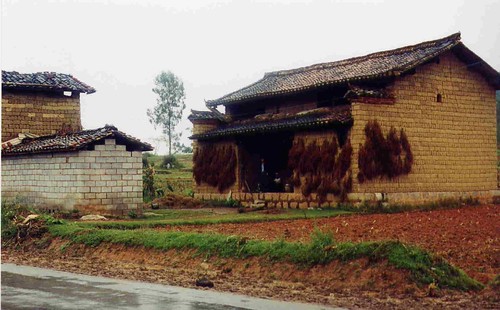
I have had the luxury and the privilege of traveling outside the US. I have been allowed to visit remote villages both in Mexico and in China. I was very surprised by the similarity of the two.
A rice paddy is drained and allowed to dry to just the right consistency. It is then scored into brick shapes, roughly 8"x 14" x 4". The bricks are removed from the paddy and allowed to dry further. I am not sure if they are "fired" but judging by the deterioration of old structures I do not believe they are. Then the next home is built. But "home" is to restrictive a label - home/barn/stall/pen/silo/hay loft/warehouse/et al.
Only subtle architectural detail differentiates the mud homes in China from the mud homes in Mexico.
Pictured here is the People's Home of rural China. This is a standard 5 room house. The central room fronted by the porch in the middle and is flanked by two rooms on either side. Above is a open loft.
In one of these homes that I visited the cooking area was inside. I did not find any inside plumbing. More often than not one of the five rooms contained livestock.
The Tobacco barn, picture at the top, is of particular note. Applied to the walls surrounding the hearth are "fuel" patties. A mixture of coal dust and organic material, primarily cattle dung is formed into patties and then slapped against the wall to dry. Later they will be peeled off and use in the hearth to cure the tobacco hung in the tobacco barn.
Below is an excerpt from the EIA's statistics of World Energy Consumption. What is of significance is the disparity of energy use verses population. China with an estimated population of 1.3 Billion people use 20% less energy than the United States with an estimated population of approximately 301 Million people.
Well, this is hardly a surprise: London has been awarded the honor of being the most expensive city in the world for dining out.
According to a recent article in the Guardian, a typical three-course meal and a glass of wine now costs an average of $79 per person in the British capital. Ouch!
Paris takes second place with $72. Tokyo averages $71 while New York comes in at a comparatively cheap $39.
The data is based upon the ubiquitous Zagat Guide. The most recent London edition has just been published and the 2.9% increase in the average cost of a meal from last year's edition has concerned local foodies. As for myself, London just keeps dropping lower and lower on my list of places to visit. I'd rather just hang out in New York where the food is half the cost. And, of course, much tastier!
The goal of this activity is to experientially heighten awareness about the overabundance of food in Western society, particularly in comparison with how much the majority of the world eats.
Cook a World Meal and share it with a group of people.
A World Meal is the average meal for the average person on the planet. It consists of a limited amount of rice and beans.
Herbs and spices are optional; as is anything you can forage from the local natural environment.
Encourage the group to, in turn, to cook a World Meal for a different group of people and thereby spread experiential awareness of how much we overconsume in Western society.
Continue cooking World Meals for groups of people at least until you've activated a critical mass of awareness for a snowball effect.
(Source: Clive Offley, Food - The Facts, New Internationalist, Issue 225, November, 1991)
By MIGUEL HELFT and BRAD STONE Published: November 2, 2007
SAN FRANCISCO, Nov. 1 — MySpace and Bebo, two of the world’s largest social networking sites, on Thursday joined a Google-led alliance that is promoting a common set of standards for software developers to write programs for social networks. ... “OpenSocial is going to be become the de facto standard for developers right out of the gate,” said Chris DeWolfe, chief executive of MySpace, in a press conference at Google’s headquarters in Mountain View, Calif. “It will have access to 200 million users, making it way bigger than any other platform out there.”
The open standards could create a boom of innovation around social networks as applications reach more users than ever and encourage developers to create more Internet tools.
Water ... worth more than gold and necessary for survival above all other resources on earth.
And yet, over one billion men, women, and children (more than four times the population of the United States and Canada combined) do not have safe water to drink and therefore cannot live a healthy life.
Who are these people?
They are the innocent children and desperate families living in overcrowded urban ghettos, in refugee encampments, and in towns and villages too numerous to count in rural areas of developing countries.
Here, less than 50% of the population have access to safe drinking water and only 25% have access to sanitary systems.
They are unfortunate victims of drought and ever-changing environmental conditions. When drought occurs, their countryside is transformed into an arid wasteland where every living thing seems to cry out for lack of water.
These precious people do not have enough water to grow and harvest food, enough water to keep their livestock alive, enough clean water to protect themselves and their children from hunger and disease.
Running a number of common access PCs means having to lock them down tight! When I learned that Microsoft had entered the 'access management' arena I was excited. Alas, my excitement was short lived.
Turns out that in its most "secure" state the SteadyState PC will still let the users shoot themselves and the PC in the foot. My question is why didn't Microsoft go the full mile and lock the system completely? I would have thought that Microsoft would have learned again the lesson of their OSs failures. Start with everything locked and then allow users only what you want them to access.
An NPR segment this morning related concerns about Internet Privacy and the need for a "No-Track" list. Such concern is admirable. Then the question crossed my mind, "At what expense?"
I am not speaking here of the relative cost of personal Internet Privacy.
What 'real world' (my choice of words) ... what 'real world' issues are being pushed aside in favor of concerns about Internet Privacy? What slight percentage of the Family of Man can afford to be concerned about Internet Privacy?
Hungry families also face tough choices between food and basic necessities: • 41% of households had to choose between paying for food and paying for utilities and heating fuel • 32% had to choose between paying for food and paying for medicine or medical care • 18% had to choose between paying for food and paying for rent or mortgage
This is certainly only one example. It is not "exciting". It doesn't have political "sex" appeal. So this and other issue stand in the shadow of Internet Privacy? At what expense?
The Saint, my wife of some twenty-fourish years, is a Scrabble addict. Very early in the morning and very late at night she is found staring bleary eyed at an assortment of consonants and not enough vowels. She plays against the computer because ... well, it is just more convenient. (I am not even sure of the program she plays - I could find out if I took the time.) One thing is clear - the price per game per play has fallen to the point where the author should consider paying her to play the game. My point is that she has gotten much more than her initial capital outlay for the game AND she doesn't have to pay for it again and again and again.
Out of curiosity I am now going to open another Firefox tab, enter some cryptic Google criteria and see if... Aha! Just as I thought... Internet Scrabble Club ... I registered my user name, password and my e-mail address. Downloaded the java interface and BINGO! Er, uh, I mean... SCRABBLE!
Now wait just a tile-sorting minute... I am not advocating the ISC. Not even if I were to get a triple word score for "apostate" or some such... My point is that we don't need contrived SocialSewingCircles or Walled-Gardens when the Internet is the greater "social network". Marshall McLuhan and Pogo were/are right: "We have met the message and it is us."
It is only when self-serving bottom-line profit-margin hyphenated-a$$holes attempt to extract their pound of flesh that we end up "needing" social communities. In part it is our own failings. We want to belong. We want to belong to something other than the greater population. So Monied interests pander to our desires, our wants and our fears. All the while putting advertisements in front of our eye-balls.
And while I am on a rant&roll ... how about those purveyors of "Love"? Purveying and preying on the most vulnerable, those "lookin' fer love [in all the wrong places]." Preying on the most basic, deep seated, human need/desire... to be loved. Offering the man or woman of your dreams... s/he is just a click away. Just enter all your vital statistics, all your private information, all your deepest secrets...and Oh yeah, your credit card number and we will fix you right up. "Step right up, ...
Step right up step right up step right up Everyone's a winner, bargains galore That's right, you too can be the proud owner Of the quality goes in before the name goes on One-tenth of a dollar
It is as if the world was too big, the universe too vast, the Internet too ... too something-or-other... we need to be members of some smaller order, some familiar covenant, some little comfort zone. We want to belong and the only way we can make that distinction for ourselves is with a small lapel pin label: FaceBookMySpaceEtAl. When in fact we are all engaged in the greatest social network known to mankind: The Internet.
Seth Godin: I know you are enamored with those little contradictions in life and advertising... but I really think you missed the "ice-cream-for-the-freezer" on this one... give it another look.
Ubuntu is still a little "rough"... according to the WSJ.
PERSONAL TECHNOLOGY
By WALTER S. MOSSBERG
This column is written for mainstream, nontechie users of digital technology. These folks aren't necessarily novices, and they aren't afraid of computers. They also aren't stupid. They simply want their digital products to operate as promised, with as little maintenance and hassle as possible.
So, I have steered away from recommending Linux, the free computer operating system that is the darling of many techies and IT managers, and a challenger to Microsoft's dominant Windows and Apple's resurgent Macintosh operating system, OS X. Linux, which runs on the same hardware as Windows, has always required much more technical expertise and a yen for tinkering than average users possess. ...
I've been testing one of those Dell Ubuntu computers, a laptop called the Inspiron 1420N. I evaluated it strictly from the point of view of an average user, someone who wouldn't want to enter text commands, hunt the Web for drivers and enabling software, or learn a whole new user interface. I focused on Ubuntu and the software programs that come bundled with it, not on the hardware, which is a pretty typical Dell laptop.
My verdict: Even in the relatively slick Ubuntu variation, Linux is still too rough around the edges for the vast majority of computer users. ...
Emphasis mine...
If an individual had grown up with something other than Windows would they still be able to consider themselves "average"? I suggest that if an individual had made an equivalent investment in Linux their expectations would be considerably different than if he/she started with Windows today. (If a person grew up speaking English all of their life how would the feel about being thrust into Chinese?)
We have all 'grown up' dealing with the vagaries of Windows. We survived the years and years of BSODs. We still have to accept 'crashes' as a fact of life. AND we still have to accept BigBrother Bill&Steve telling us what is right/good for us. Excuse me but exactly what is the Windows promise? To me this smacks of 'better the devil you know'. I have news: The Devil is still the Devil.
I am an "average" Linux user. I started with Linux in 1997-98. My work with Ubuntu, though it is not my favorite distro, clearly indicates that it is very smooth. So a much superior Operating System (OS) coupled with an excellent Graphical User Interface (GUI) makes Linux the hands-down winner in my book.
I have previously posted about AWM (which is not to be confused with Ardent Window Manager). Alpt-wm is the ultra simple, ultra small and BLAZINGLY FAST window manager...
http://freaknet.org/alpt/src/alpt-wm svn co http://dev.hinezumi.org/svnroot/alpt-wm
alpt-wm - dynamic window manager ================================ This is my custom, window manager. It's small, functional and fast. It is based on dwm ( http://www.suckless.org/wiki/dwm ) and it is just ~1800 lines of code.
...with absolutely NO bells and whistles. So what could be so good about something sooooo small?
Anyone remember screen ? It is the gift to console multitaskers ,particularly when ssh-ed into another system. AWM is to xwindows as screen is to the console. I am tempted to show a couple of screen captures but they would just take up bandwidth.
The Matrix revisited...
AWM allows the user to create a matrix of virtual desktops. X1, Y1 is the first. X1, Y2 is to the right of X1, Y1. X2, Y1 is above X1, Y1 and so on. Ctrl-Alt-RightArrow moves from 1,1 to 1,2 or Alt-Shift-UpArrow moves from 1,1 to 2,1. Each virtual desktop is created as you move to it. I just tried and I made 1,20. Certainly there are memory limitations but the point is that you can make the number of virtual desktops that you need at any given time.
So, I generally start out with two. The first runs a full screen xterm console. No frames, no menu bar, no clashing keymapping. Just a plain and simple CLI. Just like the good old days. But then comes the really great part. On my "second" virtual desktop I start an instance of FireFox, FULL SCREEN (yeah, yeah, I am yelling...'cause I am excited. Whatyawant?)
This is important, why? Why, because running on a IBM R51 laptop means that I only have 1024x768 to begin with. I am excited because I can run my X apps without taking the automatic GUI real estate hit.
So let me recap. I get a nearly unlimited number of virtual desktops. I get full screen console CLI and I get X apps all at the same time. All in about 19 megabytes of memory! (Emphasis mine! :) )
Those are the PROS... ...here are some CONS:
AWM doesn't do anything for you. It is all up to you.
You must start programs from the command line (if you didn't "hard" code them into config.h before you recompiled.)
You have to "remember" what program is running on which virtual desktop.
As any parent can tell you there is little difference between a child's perception of want and need. In the field of IT I have observed that customers as well distinguish only slightly between their wants and needs. Clearly I remember the users at one customer's site insisting that they needed sound cards for each of their PCs. Unlike today, PCs were both very costly and poorly appointed when they arrived from the manufacturer. Adding a sound card to each PC was both economically costly as well as person-power intensive. All for what? So that the users could hear "You've got mail!" Beyond that "need" there was no other business line objective being met by the expenditure of time and money on sound cards.
[Digression: (Sound Card = $65.00 + Person-hours (2 per PC @ $35.00/Hr) = $70.00) x 35 PCs = $4,725.00 = "Oh yeah! You got mail, baby. And the company got pwned!" ...but I digress.]
...changing perspectives...
My interest was piqued by an entry in the Freshmeat.net listing this morning. AWM is listed as a minimal windowing environment.
It's small, functional, and fast. It is based on dwm and is just ~1800 lines of code.
I am a Linux gadget geek and so the prospect of a minimal window manager just begged to be explored. The entire tarball for awm-0.0.7.tar.bz2 lists ( ls -alth ) at just 20K. A window manager in less than 20K (~1800 lines of code). Unbelievable!
AWM is such a small program that configuring it is a matter of editing a config.h file before compiling. When I compiled it and it didn't offer the expected console window I checked config.h and it wanted rxterm. Slackware 12 doesn't have an rxterm. So I just deleted the "r" and recompiled.
BINGO!
I have a really simple and FAST window manager. Very cool... but that is not really the changing perspective I wanted to talk about here.
AWM does not do anything beyond display the window(s) and allow the user to move among virtual "desktops". There are no short-cuts, no icons, no menus, no nothing! AWM does almost* nothing for the user. As such the user gets to make all the decisions about what programs get run. Once the decision(s) are made then it is up the the user to manually start the program(s). It is at this point that my perspective is beginning to change...radically.
In this minimalist environment I am prompted to evaluate exactly what my needs are compared to what my wants might be. Do I "need" all the bells and eye-candy whistles in order to have a fulfilling computer experience. What to I really want? And more importantly, what do I really need?
My conclusions are as minimal as AWM.
I need a command prompt (xterm) so that I can run the script that connects my PCMCIA wireless network card to my home network. (Ctrl-Alt-x)*
I need to start my browser, Firefox, to access all of my Web 2.0 base applications. (Ctrl-Alt-f)*
I want to run Pidgin (my IM client) on a different virtual "desktop" so I change to it (Ctrl-Alt-RightArrow)
I then need to start anther console (xterm) so that I can start Pidgin. (Ctrl-Alt-x)*
I want to move the Pidgin window to the upper right corner of the desktop. (Ctrl-LeftButton-Drag)
Earlier I said AWM does almost* nothing for the user. The "*" alludes to the reconfigurability of AWM. In the case of FireFox the author, Alpt, graciously gave a working example in the config.h file for GeekHacks like me to get up and running. Simple additions to the config.h file (and then recompile) allows the user to "configure" AWM's keybindings any way they may choose.
Note: After I figured out the Slackware vs. rxterm issue I purposely went back and put the "r" back into the config.h file. This effectively prevents AWM from starting a command console window on every virtual desktop. Instead I bound xterm to the Ctrl-Alt-x keystrok combination. That allows me to start a command console window only when I want to. AWM ROCKZ!!!
So here is the ...changing perspectives... bottom line: I rely on FireFox and Pidgin for the majority of my computing wants. I need a simple window manager so that I can run these two programs. I do not need all the rest of the stuff that comes with my Slackware 12 distribution.
It is this perspective that makes me mumble and grumble when customers call up and tell me that they have to have the latest and greatest soft/hardware. "I need it. I just can't get along without it."
...Git along little doggies, git along...
Bonus Video (Longish, you don't need to watch the entire full length feature.)
"Tell me what you want, what you really really want..."
My Citizen Commuter Permit (CCP) says 6:15 to 7:15 AM and 4:15 to 5:15 PM. I was able to convince the Civilian Transportation Board (CTB) that with an extended window I could take my children to school on the way to work thereby saving a significant amount of fuel. The Transportation board finally agreed and wrote my permit for the additional 30 minute window. They did not see fit to increase my Fuel Allotment Permit (FAP) citing my assurance of 'saving a significant amount of fuel'.
I was not really surprised about my Fuel Allotment Permit. If they really stuck to a person's recorded driving history, the one they get from each of our vehicles, I am sure the Allotment could be a much smaller. It is an allotment after all. They are not really rationing it. They are always quick to say that by permitting fuel use they can be assured of sufficient supply. Thereby insuring that everybody gets there fair share.
We all understand that if the Fuel Allotment Board (FAB) were to calculate our usage more exactly then the World Oil Conglomerate (WOC) would begin to grouse. Lower profits for the Conglomerate would in turn cause them to reduce the supply. We all know that the FAB is really protecting us from the usury and opportunistic meddling of an outside influence on our great country's fragile economy.
We all know that the FAB is protecting the WOC from us. By offering the fine line illusion that there is sufficient amount of albeit expensive petroleum based fuel the FAB is keeping the radical bio-mass-fuelers at bay. The FAB knows well how quickly garages and garden sheds would be turned into micro refineries (ethanol stills). Soy beans, field corn and grass clippings would all be in short supply.
The Public Information Bureau (PIB) released a statement today that the last W*l-mart in our region has closed. PIB reported that due to the collapse of the "Free Trade Agreements" with other members of our World Community that the prices for non-durable goods could no longer be properly controlled. Fearing what they said could only be characterized as radical or terrorist free market forces on pricing structures the Consumer Protection Board (CPB) had little choice but to curtail all imports of non-durable goods for the foreseeable future.
Heralding the CPB's decision to curtail imports as a 'real achievement in the balancing of trade" the Office of Federal Economic Organizations (OFEO) predicted that the country would stop "hemorrhaging" jobs to the cheap labor of those radical and terroristic free marketeers that are intent on debasing our freedoms and challenging our way of life.
OFEO officials estimated that within 18 months to two years citizens of our great nation will be producing those same items at those same prices. "Jobs will be plentiful as citizens of this great nation work at base pay to insure the American way of life. Young people, as well as the elderly, in this country will never have to worry about getting a job or that new pair of denim jeans they want. We can now return to a time when American Made means made in the USA."
God Bless and keep the Security Home Lights burning bright...
I wrote just moments ago (internet time) that I was having difficulty finding a definitive guide to Linux Kernel compilation. In this morning's feeds was the following...
After digging through the different HOWTOs and the Linux kernel Documentation directory, I came to the conclusion that there was no one place where all of this information could be found. It could be gleaned by referencing a few files here, and a few outdated web sites there, but this was not acceptable for anyone who did not know exactly what they were looking for in the first place.
SPECIAL NOTE: Even more important than offering this book for free under the CC License is the awareness that I am much more inclined to purchase a paper copy of this book. In fact we who support the likes of the CC License are obligated to show our support of such efforts by making sure the authors are paid for the fine work that they do.
Henry Ford is said to have uttered the most famous advertising line in automotive history, "You can have any color you want as long as it is black." People of his day understood implicitly his position. Steve Jobs, today, says, "You can have an iPhone." And people seem confused. They seem to think that because they want it to be TheirPhone that Jobs is at fault for merchandizing the iPhone.
WRONG!!!
People this is really really simple. If you don't want the iPhone that Jobs is selling do not buy the iPhone that Jobs is selling. Apply the 'laws' of market influences. Don't buy crap and then complain that it is not the crap you wanted to buy. Send the proper signal to Jobs. Do not buy his product unless or until he/they make it the way you really want it. Sheeeeesh, rocket science here.
You may think you speak "Standard English straight out of the dictionary" but when you step away from the Great Lakes you get asked annoying questions like "Are you from Wisconsin?" or "Are you from Chicago?" Chances are you call carbonated drinks "pop."
Being fearless and being stupid ... two sides of the same coin?
Long ago I attempted to recompile my Linux kernel - seems that the original did not support some sort of feature that I was after at the time. I saved out my original running kernel (a provision which has saved me repeatedly over the years) and issued the immortal make menuconfig command. I rummaged around until I found the possible "fix" and enabled it. I saved my new .config and then held my breath and uttered the then cryptic command incantation make - and off it went on its merry way. I copied the new kernel to /boot, reconfigured lilo to access it and held my breath. When my PC rebooted and ran the new kernel AND worked correctly I let out a huge sigh of relief and thanked the programmers each and every one. They had done it, I was just the messenger.
That was then... now I am wiser and more knowledgeable and in many cases just as ignorant as I was the very first time. So I went in search of clear and concise documentation for the mysterious .config file that is the foundation of recompiling the Linux kernel. Then I made the greatest discovery of my Linux career - and the most disheartening. I found out that I am not a geek, not by any stretch of the imagination. Sure, I can successfully recompile a kernel but truly knowing what I am doing is not the case.
So, my question and my quest is to find a good set of documents that offer real insight into the .config file contents. I have an underlying fear this is somewhat akin to asking, "What does the face of God look like?"
Oh, sure there will always be a few die-hards that don't know when to give it up and go home. For the most part every internet community that I have seriously been associated with has lost its luster and polish after about two short years. I am not talking just about FaceBook and MySpace. They are the Johnny-come-latelys. What did happen to Orkut?
I am talking about Internet Relay Chat communities that began in the late 80's. Real IRC channels with Ops and members and real rules and everything. CompuServe forums that thrived and then withered. CompuServe may be long gone (or reincarnated) but forums still exist only the people have changed repeatedly. Two, maybe three years tops and then the steam just runs out. Some times new folks show up...sometimes the old-timer just sit around and say the same things over and over again.
So my point is that it is just plain silly for pundits to claim that Twitter is the new and improved Blog. Hawg wash! Twitter is just the latest fad that has the spynsters running around in circles frothing over their keyboards. Microsoft's Ballmer, for all his foibles, has hit the FaceBook fad right on the nose. In another two years you will all have to use the "Recover Password" function to get back into your FaceBook accounts because 'time, tide and fickle consumers wait for no person'.
Having heard a prospective college student deride the value of a Liberal Arts education I must assume that society is correcting itself. The complaint, "Why should I learn stuff that I will never use?" suggests to me that the correction is one of reducing the supply of Thinkers and Artists. Evidently there are too many for the current market to bear.
If the law of Supply and Demand holds in this instance then it is about time we reduce the over abundance of frivolous Thinkers and Artists. Simply by reducing their bloated numbers we as a society can raise their respective social worth. And I say it is about time. What this country really needs are more Good-ol-boys and Home-girls. Lets put an end to this extravagance of Knowledge Workers. Lets return to a simpler time of punch-the-clock work-the-line and then go home to the suburban family.
[ End of tongue-in-cheek rant ]
I grew up continuously criticized by my peers, "Why you all the time usin' them big words?" Coming from a literate family I had an inherent sense of the meaning of words. I unconsciously used the words that expressed the width and breadth of my intended message. Later, while receiving an excellent Liberal Arts education, I came to understand that language is the living history of our society and culture. When I used 'them big words' I was then and am now rebelling against the cheapening and debasing of our real heritage: a civilized society.
I recently inherited a website and a large legacy application. Both are in-house initiatives. Custom built solely for the purposes of our manufacturing process. Previously, in my role as Manager of Information Systems, I recognized the merit and value of these entities. Their essential merit being the recording and archiving of business information. Ease of entry and subsequent reporting being paramount in their daily use. As Information Management systems they fit the hand.
When a tool fits the hand pick it up.
This has been a long standing mantra of mine when counseling customers/users regarding their computer needs and requirements. There certainly is little sense in trying to use an uncomfortable or ill-suited tool to do a job. To extend the metaphor, this a simple retelling of the old saw, 'trying to fit a square peg in a round hole.'
So all of that is the outside - I inherited the inside.
"Ease of entry and subsequent reporting..." are the result of great planning, deliberation and of course elegant execution. My predecessor did an admirable job at every turn. Alas, my predecessor embodied the living knowledge of both of these initiatives. What then falls to me is the labor of learning the insides.
Where my predecessor enjoyed the luxury of an intimate growing and evolving relationship with each project I receive each as a stone cold tool. The website and the application were crafted to fit the hand of the customer/user. The inside of each, however, as a tool fit his hand. So I now find myself having to pick up a tool that feels very foreign to my hand. A feeling that is diametrically opposed to my mantra.
I dismissed my wife's observation that this was the week that the hummingbirds would leave us. I scoffed. Just last Sunday, sitting at this very kitchen table, I watched half a dozen dance and parry for airborne superiority and territoriality. The days still feel long and hot. There are full beckoning feeders. Summer is still upon us in Kentucky. What earthly reason would prompt the hummers to forsake such bounty in favor of some other locale?
The seed feeders were empty. I could understand why the sparrows were staying away. My lack of attention to their feeding stations was unwelcoming. They had good reason to not grace us with their presence.
So I took a minute out of my busy Sunday morning ritual time and filled the seed feeders. In less than two minutes the perches were again graced by the anxious group flight behaviors of sparrow families. So simple are the joys.
Most likely we will not see the hummers again until next spring... long live the sparrows.
Sweat the garlic and onions until just translucent
Add 5 chicken livers chopped
In a separate pan brown 2 ounces (1 patty) spicy pork sausage crumble the sausage as it browns, turn it out on a piece of paper towel to remove any excess fat
Combine the sausage and chicken livers and continue over very low heat - let them become acquainted. Add small amounts of liquid (2 tablespoons of chicken stock or water) so that the mixture does not become too dry.
Add a 1/4 cup of sour cream to the mixture and continue. Add a little more liquid to maintain a thick creamy consistency. Continue to reduce.
Prepare 8 (or so) large mushrooms, washing then patting dry.
To each mushroom add a couple of drops of olive oil and one or two drops of balsamic vinegar.
Just prior to stuffing the mushrooms add two tablespoons of fine bread crumbs. This is not so much filler as it is a binder to soak up the sauce.
Stuff the mushrooms firmly with the mixture and mound as high as possible. (Usually I don't endorse such abuse of mushrooms but in this case go ahead and stuff.)
Prepare a shallow chaffing dish with a thin layer of marinara sauce (last night's lovely spaghetti sauce, thanks to The Saint). Gently float each stuffed mushroom in the dish, careful that they don't touch one another.
Place the chaffing dish in a preheated (325F) oven for 25 to 35 minutes.
Sprinkle the stuffed mushrooms with fresh grated Parmesan cheese and place under the broiler until the cheese is toasted (just begins to show color).


 This is a picture of Zhai Minglei's computer after his hard drive was removed and confiscated on




 particularly in comparison with how much the majority of the world eats.
 Encourage the group to, in turn, to cook a World Meal for a different group of people and thereby spread experiential awareness of how much we overconsume in Western society.


