Same as it ever was... Ha ha ha
Thanks Jeremy
One of the great social philosophers of our time, Steven Wright, asked the pointed question, "If you had everything where would you put it?"
The answer is very simple. "Everywhere."
If we did in fact dominate the world where would we put it? Would we rearrange the continents? Rename the countries? Demand that people change the color of their eyes? Standardize on a universal breakfast cereal?
If we did dominate the world we would leave it just as it is. Nothing would change. We would still have a world economy. Neighboring people groups would still have long standing disagreements. Some areas of the planet would be warmer/colder/wetter/drier. Local political leaders would be subject to the influences of area political leaders who in turn would be subject to the influences of regional political leaders who would be influenced by ... all the same people who are influential now.
We need to realize that no one wants to dominate the world. No one wants the responsibility of managing any more people or territory than they already have.
Let me be clear on one very serious point here: We, the world population, must remain vigilant. We cannot allow atrocities to occur.
By unburdening ourselves of fear we can begin to grow. When we stop the false "competing" that our respective governments have committed us to we can begin to work cooperatively. Instead of investing in systems and mechanisms that are designed to keep us separate and apart we can concentrate on joining together. Joining as brothers and sisters.
This is just One World. Where else would we put it?
In previous "Open" posts I have focused on the disparity of what we have verses what we need. Today I want to focus on what has come to be known as OLPC. I am astounded at the foot dragging and stone-walling that has been going on with what will be the single greatest contribution to computing community. And I know why the industry hasn't stepped up to OLPC.
My experiment with being PDAless didn't last beyond the first hour of work today Monday, 11/05/07. Can anyone guess why? Of course, DST trumps PDAless every time. The first time I had to log into an obscure video switching system to set its display clock to/from DST... required my PDA and its encrypted list of obscure passwords. Sheeeeeesh.

According to the National Restaurant Association's report Restaurant Spending -- 2004:
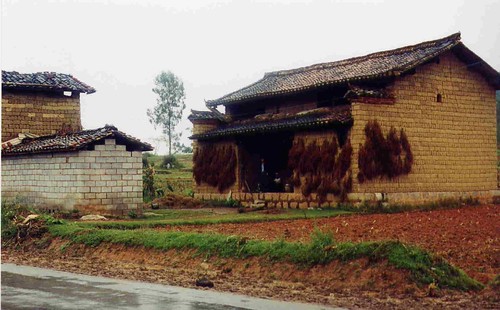 Pictured here is the People's Home of rural China. This is a standard 5 room house. The central room fronted by the porch in the middle and is flanked by two rooms on either side. Above is a open loft.

Average Meal in London now the Most Expensive in the World
Well, this is hardly a surprise: London has been awarded the honor of being the most expensive city in the world for dining out.
According to a recent article in the Guardian, a typical three-course meal and a glass of wine now costs an average of $79 per person in the British capital. Ouch!
Paris takes second place with $72. Tokyo averages $71 while New York comes in at a comparatively cheap $39.
The data is based upon the ubiquitous Zagat Guide. The most recent London edition has just been published and the 2.9% increase in the average cost of a meal from last year's edition has concerned local foodies. As for myself, London just keeps dropping lower and lower on my list of places to visit. I'd rather just hang out in New York where the food is half the cost. And, of course, much tastier!
 particularly in comparison with how much the majority of the world eats.
 Encourage the group to, in turn, to cook a World Meal for a different group of people and thereby spread experiential awareness of how much we overconsume in Western society.
 Continue cooking World Meals for groups of people at least until you've activated a critical mass of awareness for a snowball effect.
Reporting in the
MySpace Joins Google Alliance to Counter Facebook
By MIGUEL HELFT and BRAD STONE
Published: November 2, 2007
SAN FRANCISCO, Nov. 1 — MySpace and Bebo, two of the world’s largest social networking sites, on Thursday joined a Google-led alliance that is promoting a common set of standards for software developers to write programs for social networks.
...
“OpenSocial is going to be become the de facto standard for developers right out of the gate,” said Chris DeWolfe, chief executive of MySpace, in a press conference at Google’s headquarters in Mountain View, Calif. “It will have access to 200 million users, making it way bigger than any other platform out there.”
The open standards could create a boom of innovation around social networks as applications reach more users than ever and encourage developers to create more Internet tools.
Water ... worth more than gold and necessary for survival above all other resources on earth.
And yet, over one billion men, women, and children (more than four times the population of the United States and Canada combined) do not have safe water to drink and therefore cannot live a healthy life.
|
Who are these people?
They are the innocent children and desperate families living in overcrowded urban ghettos, in refugee encampments, and in towns and villages too numerous to count in rural areas of developing countries.
Here, less than 50% of the population have access to safe drinking water and only 25% have access to sanitary systems.
They are unfortunate victims of drought and ever-changing environmental conditions. When drought occurs, their countryside is transformed into an arid wasteland where every living thing seems to cry out for lack of water.
These precious people do not have enough water to grow and harvest food, enough water to keep their livestock alive, enough clean water to protect themselves and their children from hunger and disease.
They do not have enough water to survive

Running a number of common access PCs means having to lock them down tight! When I learned that Microsoft had entered the 'access management' arena I was excited. Alas, my excitement was short lived.
Turns out that in its most "secure" state the SteadyState PC will still let the users shoot themselves and the PC in the foot. My question is why didn't Microsoft go the full mile and lock the system completely? I would have thought that Microsoft would have learned again the lesson of their OSs failures. Start with everything locked and then allow users only what you want them to access.
An NPR segment this morning related concerns about Internet Privacy and the need for a "No-Track" list. Such concern is admirable. Then the question crossed my mind, "At what expense?"
I am not speaking here of the relative cost of personal Internet Privacy.
What 'real world' (my choice of words) ... what 'real world' issues are being pushed aside in favor of concerns about Internet Privacy? What slight percentage of the Family of Man can afford to be concerned about Internet Privacy?
Hungry families also face tough choicesThis is certainly only one example. It is not "exciting". It doesn't have political "sex" appeal. So this and other issue stand in the shadow of Internet Privacy? At what expense?
between food and basic necessities:
• 41% of households had to choose between paying
for food and paying for utilities and heating fuel
• 32% had to choose between paying for food and
paying for medicine or medical care
• 18% had to choose between paying for food and
paying for rent or mortgage
The Saint, my wife of some twenty-fourish years, is a Scrabble addict. Very early in the morning and very late at night she is found staring bleary eyed at an assortment of consonants and not enough vowels. She plays against the computer because ... well, it is just more convenient. (I am not even sure of the program she plays - I could find out if I took the time.) One thing is clear - the price per game per play has fallen to the point where the author should consider paying her to play the game. My point is that she has gotten much more than her initial capital outlay for the game AND she doesn't have to pay for it again and again and again.
Out of curiosity I am now going to open another Firefox tab, enter some cryptic Google criteria and see if... Aha! Just as I thought... Internet Scrabble Club ... I registered my user name, password and my e-mail address. Downloaded the java interface and BINGO! Er, uh, I mean... SCRABBLE!
Now wait just a tile-sorting minute... I am not advocating the ISC. Not even if I were to get a triple word score for "apostate" or some such... My point is that we don't need contrived SocialSewingCircles or Walled-Gardens when the Internet is the greater "social network". Marshall McLuhan and Pogo were/are right: "We have met the message and it is us."
It is only when self-serving bottom-line profit-margin hyphenated-a$$holes attempt to extract their pound of flesh that we end up "needing" social communities. In part it is our own failings. We want to belong. We want to belong to something other than the greater population. So Monied interests pander to our desires, our wants and our fears. All the while putting advertisements in front of our eye-balls.
And while I am on a rant&roll ... how about those purveyors of "Love"? Purveying and preying on the most vulnerable, those "lookin' fer love [in all the wrong places]." Preying on the most basic, deep seated, human need/desire... to be loved. Offering the man or woman of your dreams... s/he is just a click away. Just enter all your vital statistics, all your private information, all your deepest secrets...and Oh yeah, your credit card number and we will fix you right up. "Step right up, ...
A desktop search engine that I didn't ask for and don't want!!!!
More to follow when I can get my anger under control.

Seth Godin: I know you are enamored with those little contradictions in life and advertising... but I really think you missed the "ice-cream-for-the-freezer" on this one... give it another look.
Ubuntu is still a little "rough"... according to the WSJ.
PERSONAL TECHNOLOGYBy WALTER S. MOSSBERG
This column is written for mainstream, nontechie users of digital technology. These folks aren't necessarily novices, and they aren't afraid of computers. They also aren't stupid. They simply want their digital products to operate as promised, with as little maintenance and hassle as possible.Emphasis mine...
So, I have steered away from recommending Linux, the free computer operating system that is the darling of many techies and IT managers, and a challenger to Microsoft's dominant Windows and Apple's resurgent Macintosh operating system, OS X. Linux, which runs on the same hardware as Windows, has always required much more technical expertise and a yen for tinkering than average users possess.
...I've been testing one of those Dell Ubuntu computers, a laptop called the Inspiron 1420N. I evaluated it strictly from the point of view of an average user, someone who wouldn't want to enter text commands, hunt the Web for drivers and enabling software, or learn a whole new user interface. I focused on Ubuntu and the software programs that come bundled with it, not on the hardware, which is a pretty typical Dell laptop.
My verdict: Even in the relatively slick Ubuntu variation, Linux is still too rough around the edges for the vast majority of computer users.
...
I have previously posted about AWM (which is not to be confused with Ardent Window Manager). Alpt-wm is the ultra simple, ultra small and BLAZINGLY FAST window manager...
http://freaknet.org/alpt/src/alpt-wm
svn co http://dev.hinezumi.org/svnroot/alpt-wm
alpt-wm - dynamic window manager
================================
This is my custom, window manager. It's small, functional and fast.
It is based on dwm ( http://www.suckless.org/wiki/dwm ) and it is just ~1800 lines of code.


