Monday, November 19, 2007

Open Advertising (???)

Quick! Tell me about two commercials you saw during the last Super Bowl.

Funny, neither can I. Ok, tell me the company or product offered in the banner ad in the last page you went to.

Funny, neither can I. You can only imagine how it must sound to the Marketing Survey caller when I honestly say that I cannot remember any of the advertisements in such-n-such magazine. Even though I had skimmed it only two days ago.

This awareness brings me to one of two possible conclusions. Either advertising works...on a subliminal level. Or, advertising is grossly over priced for the effect it has on the viewer.

I wonder if Advertising folks would be willing to fess up to either position? It would probably involve Lawyers speaking for the interests of the industry.

Hmmmm...

Hmmm, iffen you quote enough smart people...

cash advance

Guess these folks didn't watch the Kermit the Frog video... Same as it ever was!

Sunday, November 18, 2007

Open Responsibility

Microsoft's Bill Hilf Reveals Its Open Source Strategy

The man in charge of Microsoft's strategy for living in harmony with Linux lays out the company's opportunities with open source and the open source business model.


...

InformationWeek: Are there any specific areas where you would see Microsoft placing things in an open source development environment as a way to further its own products or to better interoperate with things?

Hilf: When people buy commercial software, really what they're buying is a guarantee. You're buying a guarantee that what you have will perform, and has been tested and there's someone you can call up, and if things go really bad someone's liable if something doesn't work. You're buying this ecosystem of accountability. One of the challenges of open source and really the challenge with the open source business model is: it's hard to replicate that ecosystem of accountability and that guarantee.

Emphasis mine.

In adopting a "Blamers" mentality we have succeeded locking ourselves into our own prison. Instead of looking for a solution to a given problem we have taken up the practice of finding someone else to blame, someone on whom we can place the responsibility.

Open Source is the antithesis of "Blamers". Open Source people, as individuals or groups, who have accepted the full and nontransferable responsibility for their work. By accepting the tenets of Open Source these people are willing to place their work under the scrutiny of the most discriminating critics. In return their work is vetted and documented to a degree that insures the very highest quality.

When we as consumers use Open Source software we are accepting that same level of responsibility. This does not mean that I, as a consumer, am "out in the cold" should I experience any difficulty with an Open Source project. To the contrary, it is the community of developers _and_ critics that rise to my assistance when I have questions or issues. They do so willingly, on their own time, and most often at their own expense.

We need to move away from "Blamers" and the blame game mentality.

Friday, November 16, 2007

Thursday, November 15, 2007

Open Silliness or World Domination

One of the great social philosophers of our time, Steven Wright, asked the pointed question, "If you had everything where would you put it?"

The answer is very simple. "Everywhere."


If we did in fact dominate the world where would we put it? Would we rearrange the continents? Rename the countries? Demand that people change the color of their eyes? Standardize on a universal breakfast cereal?

If we did dominate the world we would leave it just as it is. Nothing would change. We would still have a world economy. Neighboring people groups would still have long standing disagreements. Some areas of the planet would be warmer/colder/wetter/drier. Local political leaders would be subject to the influences of area political leaders who in turn would be subject to the influences of regional political leaders who would be influenced by ... all the same people who are influential now.

We need to realize that no one wants to dominate the world. No one wants the responsibility of managing any more people or territory than they already have.

Let me be clear on one very serious point here: We, the world population, must remain vigilant. We cannot allow atrocities to occur.

By unburdening ourselves of fear we can begin to grow. When we stop the false "competing" that our respective governments have committed us to we can begin to work cooperatively. Instead of investing in systems and mechanisms that are designed to keep us separate and apart we can concentrate on joining together. Joining as brothers and sisters.

This is just One World. Where else would we put it?

Sunday, November 11, 2007

Open Computing

In previous "Open" posts I have focused on the disparity of what we have verses what we need. Today I want to focus on what has come to be known as OLPC. I am astounded at the foot dragging and stone-walling that has been going on with what will be the single greatest contribution to computing community. And I know why the industry hasn't stepped up to OLPC.

  1. Consumer electronic manufacturers do not want to acknowledge that a functional PC can be produced for such a small price.
  2. Consumer electronic manufacturers do not want to acknowledge just how few resources the average PC user really needs.
Quickly and simply this boils down to Their profit margins and Our needs.

For too long now we have been locked into the BIG box model. Touted as 'bigger is better' and 'Mo' power!' the average consumer has been saddled with a PC that lays dormant 90+ percent of the time. This overgrowth of personal computing power has been driven lock-step by monopolistic software developers who have through rigorous legal wrangling forced us to "upgrade". All the while such upgrades offer little in the way of innovation or even real function. One need only reflect on Microsofts' Vista to see the real failing of this business model.

Were Joe P.C. Average to have a hands-on opportunity I know s/he would do very well with a small form personal computer running a small operating system. But the purveyors of behemoth applications and operating systems decry the lack of functionality. Me thinks they doth protest too much! They have chosen to "give" us what we think we want (at their direction and recommendation) instead of what we need. PC manufactures and their crony software developers should take a very real lesson from the Detroit Big Iron folks.

Remedial Math 101:

Joe Average can afford $100 for a PC. Is it better to sell one PC at $1000 or 1000 PCs at $100?

Saturday, November 10, 2007

Tuesday, November 06, 2007

FLASH: Frank Wins British Bird

...flim at 11...

Monday, November 05, 2007

PDA-less-ness

My experiment with being PDAless didn't last beyond the first hour of work today Monday, 11/05/07. Can anyone guess why? Of course, DST trumps PDAless every time. The first time I had to log into an obscure video switching system to set its display clock to/from DST... required my PDA and its encrypted list of obscure passwords. Sheeeeeesh.


Although DST is common in Europe and North America, most of the world's people do not use it.      DST used      DST no longer used      DST never used
Although DST is common in Europe and North America, most of the world's people do not use it.
DST used
DST no longer used
DST never used

Open Kitchen

Restaurant Spending

According to the National Restaurant Association's report Restaurant Spending -- 2004:

  • The typical American household spent an average of $2,434 on food away from home in 2004. Per-capita expenditures on food away from home averaged $974 that year.
  • Households with incomes of $70,000 and over spent an average of $4,308 ($1,390 per capita) on food away from home in 2004. Close to half (47.6 percent) of the total food dollar in these households was spent on food away from home.
Citing speed, convenience and variety Americans are spending "Close to half (47.6 percent) of the total food dollar in these households was spent on food away from home." To me this means two very important things: first, Americans, particularly young people, are not practicing their cooking. Second, the American family is spending even less time in what should be the most revered and honored room in the house, The Kitchen.

When we stop upholding the value of food in our daily lives. When we relinquish the skills of preparation and presentation. When we give up the communion of family meals then we throw ourselves at the feet of the Food Processors.

My children were both fascinated with and horrified by Soylent Green. They it saw it through new eyes. They, who are only interested in microwaving instant meals, couldn't understand the import of a stalk of limp celery. They, who have yet to live for weeks on end eating rama noodles, didn't recognize the succulent, evocative implications of eating strawberry preserves one salacious spoon- licking bite at a time.

It is time to get back to the Sacristy of the Kitchen before it is too late.

Online Etymology Dictionary - Cite This Source - Share This
sacristy
"repository of sacred things," 1601, from Anglo-Fr. sacrestie, from M.L. sacrista, from L. sacer "sacred" (see sacred).

BONUS LINK: Soylent Green T-shirts (not for the faint of heart).

Sunday, November 04, 2007

Homemade chocolate chip cookies

...need I say more?

Open BTUs


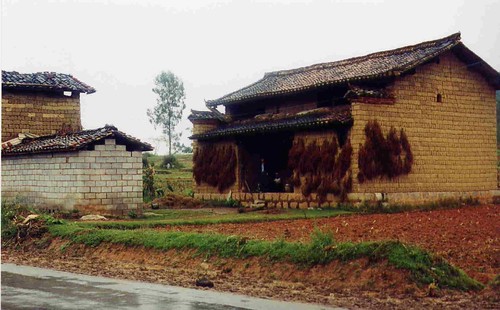
19_Tobacco_barn
Originally uploaded by william_meloney
I have had the luxury and the privilege of traveling outside the US. I have been allowed to visit remote villages both in Mexico and in China. I was very surprised by the similarity of the two.

A rice paddy is drained and allowed to dry to just the right consistency. It is then scored into brick shapes, roughly 8"x 14" x 4". The bricks are removed from the paddy and allowed to dry further. I am not sure if they are "fired" but judging by the deterioration of old structures I do not believe they are. Then the next home is built. But "home" is to restrictive a label - home/barn/stall/pen/silo/hay loft/warehouse/et al.

Only subtle architectural detail differentiates the mud homes in China from the mud homes in Mexico.

Pictured here is the People's Home of rural China. This is a standard 5 room house. The central room fronted by the porch in the middle and is flanked by two rooms on either side. Above is a open loft.

In one of these homes that I visited the cooking area was inside. I did not find any inside plumbing. More often than not one of the five rooms contained livestock.

The Tobacco barn, picture at the top, is of particular note. Applied to the walls surrounding the hearth are "fuel" patties. A mixture of coal dust and organic material, primarily cattle dung is formed into patties and then slapped against the wall to dry. Later they will be peeled off and use in the hearth to cure the tobacco hung in the tobacco barn.

Below is an excerpt from the EIA's statistics of World Energy Consumption. What is of significance is the disparity of energy use verses population. China with an estimated population of 1.3 Billion people use 20% less energy than the United States with an estimated population of approximately 301 Million people.


This large table shows world energy consumption by region, from 2004-2030, for OECD countries and Non-OECD countries. For more information, contact: National Energy Information Center at 202.586.8800.

Saturday, November 03, 2007

Word up

Open Table

Average Meal in London now the Most Expensive in the World

Well, this is hardly a surprise: London has been awarded the honor of being the most expensive city in the world for dining out.

According to a recent article in the Guardian, a typical three-course meal and a glass of wine now costs an average of $79 per person in the British capital. Ouch!

Paris takes second place with $72. Tokyo averages $71 while New York comes in at a comparatively cheap $39.

The data is based upon the ubiquitous Zagat Guide. The most recent London edition has just been published and the 2.9% increase in the average cost of a meal from last year's edition has concerned local foodies. As for myself, London just keeps dropping lower and lower on my list of places to visit. I'd rather just hang out in New York where the food is half the cost. And, of course, much tastier!

World Meal

  • The goal of this activity is to experientially heighten awareness about the overabundance of food in Western society, particularly in comparison with how much the majority of the world eats.
  • Cook a World Meal and share it with a group of people.
  • A World Meal is the average meal for the average person on the planet. It consists of a limited amount of rice and beans.
  • Herbs and spices are optional; as is anything you can forage from the local natural environment.
  • Encourage the group to, in turn, to cook a World Meal for a different group of people and thereby spread experiential awareness of how much we overconsume in Western society.
  • Continue cooking World Meals for groups of people at least until you've activated a critical mass of awareness for a snowball effect.


(Source: Clive Offley, Food - The Facts, New Internationalist, Issue 225, November, 1991)

Friday, November 02, 2007

Open Water

Reporting in the

Friday, November 2, 2007
MySpace Joins Google Alliance to Counter Facebook

By MIGUEL HELFT and BRAD STONE
Published: November 2, 2007

SAN FRANCISCO, Nov. 1 — MySpace and Bebo, two of the world’s largest social networking sites, on Thursday joined a Google-led alliance that is promoting a common set of standards for software developers to write programs for social networks.
...
“OpenSocial is going to be become the de facto standard for developers right out of the gate,” said Chris DeWolfe, chief executive of MySpace, in a press conference at Google’s headquarters in Mountain View, Calif. “It will have access to 200 million users, making it way bigger than any other platform out there.”

The open standards could create a boom of innovation around social networks as applications reach more users than ever and encourage developers to create more Internet tools.

Water ... worth more than gold and necessary for survival above all other resources on earth.

And yet, over one billion men, women, and children (more than four times the population of the United States and Canada combined) do not have safe water to drink and therefore cannot live a healthy life.

GlobalWater.org

Who are these people?

They are the innocent children and desperate families living in overcrowded urban ghettos, in refugee encampments, and in towns and villages too numerous to count in rural areas of developing countries.

Here, less than 50% of the population have access to safe drinking water and only 25% have access to sanitary systems.

They are unfortunate victims of drought and ever-changing environmental conditions. When drought occurs, their countryside is transformed into an arid wasteland where every living thing seems to cry out for lack of water.

These precious people do not have enough water to grow and harvest food, enough water to keep their livestock alive, enough clean water to protect themselves and their children from hunger and disease.


They do not have enough water to survive

Thursday, November 01, 2007

Microsoft Windows SteadyState shakey at best....

Running a number of common access PCs means having to lock them down tight! When I learned that Microsoft had entered the 'access management' arena I was excited. Alas, my excitement was short lived.

Turns out that in its most "secure" state the SteadyState PC will still let the users shoot themselves and the PC in the foot. My question is why didn't Microsoft go the full mile and lock the system completely? I would have thought that Microsoft would have learned again the lesson of their OSs failures. Start with everything locked and then allow users only what you want them to access.

At what expense?

An NPR segment this morning related concerns about Internet Privacy and the need for a "No-Track" list. Such concern is admirable. Then the question crossed my mind, "At what expense?"

I am not speaking here of the relative cost of personal Internet Privacy.

What 'real world' (my choice of words) ... what 'real world' issues are being pushed aside in favor of concerns about Internet Privacy? What slight percentage of the Family of Man can afford to be concerned about Internet Privacy?

Hungry families also face tough choices
between food and basic necessities:
• 41% of households had to choose between paying
for food and paying for utilities and heating fuel
• 32% had to choose between paying for food and
paying for medicine or medical care
• 18% had to choose between paying for food and
paying for rent or mortgage
This is certainly only one example. It is not "exciting". It doesn't have political "sex" appeal. So this and other issue stand in the shadow of Internet Privacy? At what expense?

Tuesday, October 30, 2007

Cat Stevens Yusuf Islam Father and Son 2007

Just another FaceBook in the crowd (2)

The Saint, my wife of some twenty-fourish years, is a Scrabble addict. Very early in the morning and very late at night she is found staring bleary eyed at an assortment of consonants and not enough vowels. She plays against the computer because ... well, it is just more convenient. (I am not even sure of the program she plays - I could find out if I took the time.) One thing is clear - the price per game per play has fallen to the point where the author should consider paying her to play the game. My point is that she has gotten much more than her initial capital outlay for the game AND she doesn't have to pay for it again and again and again.

Out of curiosity I am now going to open another Firefox tab, enter some cryptic Google criteria and see if... Aha! Just as I thought... Internet Scrabble Club ... I registered my user name, password and my e-mail address. Downloaded the java interface and BINGO! Er, uh, I mean... SCRABBLE!

Now wait just a tile-sorting minute... I am not advocating the ISC. Not even if I were to get a triple word score for "apostate" or some such... My point is that we don't need contrived SocialSewingCircles or Walled-Gardens when the Internet is the greater "social network". Marshall McLuhan and Pogo were/are right: "We have met the message and it is us."

It is only when self-serving bottom-line profit-margin hyphenated-a$$holes attempt to extract their pound of flesh that we end up "needing" social communities. In part it is our own failings. We want to belong. We want to belong to something other than the greater population. So Monied interests pander to our desires, our wants and our fears. All the while putting advertisements in front of our eye-balls.

And while I am on a rant&roll ... how about those purveyors of "Love"? Purveying and preying on the most vulnerable, those "lookin' fer love [in all the wrong places]." Preying on the most basic, deep seated, human need/desire... to be loved. Offering the man or woman of your dreams... s/he is just a click away. Just enter all your vital statistics, all your private information, all your deepest secrets...and Oh yeah, your credit card number and we will fix you right up. "Step right up, ...

Step right up
step right up
step right up
Everyone's a winner, bargains galore
That's right, you too can be the proud owner
Of the quality goes in before the name goes on
One-tenth of a dollar

It is as if the world was too big, the universe too vast, the Internet too ... too something-or-other... we need to be members of some smaller order, some familiar covenant, some little comfort zone. We want to belong and the only way we can make that distinction for ourselves is with a small lapel pin label: FaceBookMySpaceEtAl. When in fact we are all engaged in the greatest social network known to mankind: The Internet.


Friday, October 26, 2007

Class Action Lawsuit: Microsoft steals CPU cycles, slows users PC without permission

A desktop search engine that I didn't ask for and don't want!!!!

More to follow when I can get my anger under control.

. . .